What Makes Marble Rally Events Distinct
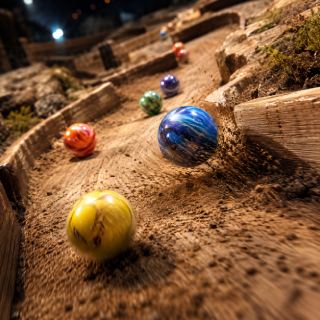
At their core, marble rally events are off-road-style races where marbles travel downhill courses shaped by sand, funnels, bumps, and narrow channels rather than rigid enclosed lanes. The terrain does most of the work. Gravity pulls competitors through unpredictable paths where a single bump can send a frontrunner sideways and a trailing marble suddenly onto the podium.
Unlike circuit racing, there's no looping the same track repeatedly. Each run is a single downhill attempt, and finishing positions are decided in seconds. Some events use elimination rounds, cutting the lowest finishers after each heat until only a handful remain.
Seasons typically string multiple events together into a championship format, with points accumulating across races. Fans track standings the same way they would in any motorsport series. The Sand Marble Rally, one of the most-watched examples, draws thousands of viewers per event precisely because no two races ever play out the same way.
Why Rally Formats Feel Different From Circuit Racing
Circuit racing rewards precision. Marbles that hold a clean line through repeated laps tend to dominate, and the fastest qualifier often leads from start to finish. Rally formats strip that predictability away almost entirely.
Terrain does most of the work in a rally event. Gravity, surface texture, and course shape determine pace more than any consistent marble quality. A marble that builds momentum through an early downhill section might lose everything to a narrow funnel or an unexpected bump mid-course. There's no recovering a clean line when the track itself keeps shifting the variables.
Lead changes in rally racing happen without warning. A marble that looks comfortable in third can surge to first through a single well-timed bounce off a barrier. Strong starts rarely guarantee results because conditions change as the field spreads out across the course.
Viewers tend to stay more alert watching rally formats for exactly that reason. The track is unpredictable in a way that a circuit simply isn't.
How Course Design Creates the Drama Fans Remember
Sand tracks are the foundation of most marble rally courses, and their grip-reducing surface immediately separates controlled racing from pure momentum management. A marble entering a sandy descent too fast will slide wide, lose its racing line, and drop positions in seconds.
Funnels and narrow choke points are where the real chaos happens. When several marbles converge on a single-width channel simultaneously, the bunching effect compresses the field and erases comfortable leads. A marble that dominated an open section can exit a funnel in fourth place.
Bumps and barriers introduce unpredictable deflections. Even slight variations in a marble's angle off a bump can send it into a completely different trajectory, triggering sudden overtakes that no viewer saw coming.
Transition zones between surface types, say, shifting from packed dirt to loose sand, act almost like hidden traps. Leaders carrying too much speed through a transition frequently lose control precisely when they can least afford it.
The Best Marble Rally Events Reward Controlled Chaos
Terrain, obstacles, and shifting conditions aren't background details in marble racing – they're the whole point. A marble that leads through a sandy funnel can lose ground completely on a bumpy descent, and no amount of prior performance guarantees anything once the course tightens into a narrow channel. That unpredictability isn't a flaw in the format; it's exactly why fans keep watching. Standings shift late, dramatic overtakes happen in places nobody expected, and each race feels genuinely different from the last even on a familiar track. There's no denying the appeal of a competition where the course itself has a say in the outcome. For fans who enjoy tight finishes and real tension, marble rally events deliver something circuit-style racing rarely can – a format where chaos is managed just enough to stay exciting, but never so controlled that the result feels inevitable.